Wednesday, March 13, 2019
P4- Create a pre-production plan for the animation RESUBMISSION.
Gantt Chart:
Mood Board:
My Mood Board shows all the things that are influencing and inspiring my animation. For example, the different texts that I might use in my animation, or the colour scheme That I plan to use. In my mood board I have different pictures of music notes in different colours as I plan to use music notes of those colours (pinks, yellows and blues) in my animation and flowing along a swirled steve in my animation as well. I have a picture of a man made out of different music notes to inspire my character as his head is going to be a music head. I also have a picture of a man juggling as I plan to have my main character juggling. I also have lots of different colourful pictures and squares to show my colour scheme for the animation.
Production Schedule:
Risk Assessment:
M1: Assess the suitability of animations for the target audience RESUBMISSION.
‘Toy Story 3’ is a Pixar animated film released in 2010. ‘Toy Story 3’ is the third instalment in Pixar’s debut film series ‘Toy Story’. It is a 3D computer animated film starring Tim Alan as ‘Buzz Lightyear’ and Tom Hanks as ‘Woody’. ‘Toy Story 3’ was originally released in cinemas June 18th 2010 and then released to buy on DVD/Blu-ray later in the year. Since then it has been available on streaming site such as Netflix. The film has previously been on streaming site, this makes it easier for 21st century children to be able to watch it as using smart tablets and apps as children seem to be naturally fluent in using this sort of tech, much more then learning how to use a DVD player.
For this film, I would suggest that the target audience is children and their older siblings or parents. I would say that this is the target audience because of the age rating being Universal and suitable for all viewers. Also, the whimsical nature of this film being about children’s toys who come to life is the perfect narrative for children as it would be almost a dream-come-true. It plays with the ideas of what the children imagine when they are playing with their own toys and therefore, it becomes easy for the children to relate to the film. The film is also aimed at older teenagers and adults, as older siblings or parents would take their children to watch the film. This is shown through sensitive themes like maturity and outgrowing their toys. This is a theme that adults will be able to relate to, more especially older teenagers as this is something that would have happened to them more recently. Another important factor to consider when determining the target audience for ‘Toy Story 3’ is that it is a sequel for the film ‘Toy Story that came out in 1995, fifteen years before ‘Toy Story 3’. This would mean that any children who watched the original when it came out in 1995, would be fifteen years older, and would be a similar age to the now grown up Andy.
One example of how 'Toy Story 3' meets it's target audience in the scene where Ken is showing Barbie all his clothes. This scene show's the film's target audience as the film as it is funny and ridiculous to the children, as well as the amusing shots and the song Le Freak by Chic (which the children would find amusing as it is funky) the scene would be very amusing and therefore would meet the target audience of children. This scene relates to the adult section of the target audience as they would appreciate the clothes and would be familiar with the song as the adults who would have grown up in the 70s-80s would recognise these 'outdated' clothes as these were the clothes that they would probably have worn or would have seen other people wear as they were growing up.
Another example of how 'Toy Story 3' meets the target audience is in the opening scene. In this scene, we see the inside of Andy's head as he plays with his toys. This meets the target audience as it is relatable for the children as this is the sort of thing that runs through their head when they play with their toys. This scene is also relatable for their audience as through this scene they are reminded what it was like to be a child and to have the limits of reality stretch through their imagination. For the adults who are watching, this is replicated in the final scene where we see Andy and Barney playing with the toys, but not from the perspective of a child's imagination, but through the eyes of an adult.
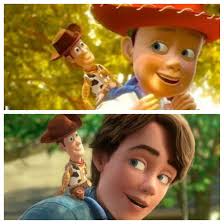
‘Toy Story 3’ is a feature length animation; it is 1hour 48minutes. This is a good length of time for a children’s film as it is not too long that it would bore them. As well as this, the time of the film is a good length as has enough time to get the story across in a suitable amount of detail without having the film go on for too long.
In this eye level two shot, we can see Buzz Lightyear light in the moonlight. The use of lighting in this shot shows us that he is of importance. However Jessie, who is in the background, is in shadows which tells the audience that she is no longer though of as important and is to be treated without dignity. This is solidified by the bars separating her from the person she used to trust. As well as this, the bars solidify her lack of freedom; she has been locked away and has practically no power. This is shown through her taking up a very small amount of space within the shot, whereas Buzz is taking up most of the room in the shot which tells the audience that he is the one with all the power.
In this low angle shot of Lotso, the audience an tell that he has all of the power over the other's fate. This is shown by the low angle as the audience are physically looking up at him. As well as this, we can see he has all the power as he is standing next to the button that will free the others from a certain death, but the distance between Lotso and the button show the audience that he will not free them. Within the shot, there is a red glow (from the incinerator) which not only is a reminder of the death that awaits the others, but also makes the audience think about the bloodshed, and the love that the friends share that will die along with them as these are what is associated with the colour red.
In this high angle wide shot, we can see that the toys who are about to die, are ultimately insignificant. This is shown through making them seem small against the size of the fire. Although to us and to Andy the toys mean a lot, within their world, their absence will not make a huge difference. This makes their death even more emotional and important to the audience.
In this medium shot, the focus is on Buzz's hand which is being reached towards Woody, however the hand is reaching towards the camera and the audience behind it. This makes it as though Buzz is reaching out to comfort the audience who are also preparing themselves for the death of these characters. For audience members who have watched all of the films in the franchise since 1995, it is as if he is saying to them "we're with you to the end".
In this high angle wide shot, Woody is centred in the middle, this shows he is the main character to focus on as he was Andy's main toy. An important thing to note is that not only is he in the centre but he is also alone in the centre. In this moment, while everyone else is clinging to each other, he is without Andy and has nobody else to turn to. Also Woody is stretched out. This shows us that he was the glue that binds all the toys together. It could also show the internal conflict about loosing Andy that has been troubling him throughout the film as he is physically being pulled in to directions. This sort of scene is important in children's films as it helps prepare them for events in the future of loosing a loved one and introduces them to the idea of death.
In this shot, we can see the final stage of Todorov's theory of equilibrium as all is good again for the characters. In the first scene of the film, Andy is playing with his toys, and in this shot, we can see Barney playing with her new toys. In the foreground we can see the satisfied faces of the toys whist they are being played with, and in the background we can see Barney playing with her new toys. This shows that there will be a new equilibrium where the toys get played with regularly again. This is emphasised by the pathetic fallacy in the shot, the weather is a beautiful sunny day which shows us that all is great again.
This shot also shows us the final stage of Todorov's theory as it is replicates the opening shot from the original film, this tells the audience who have seen the original film that this is a new beginning for these toys and that this is not the end.
‘Spirited Away’ is a Studio Ghibli animated feature film originally released in July 2001, and then rereleased in English in 2003. ‘Spirited Away’ is a Japanese anime that has been translated into over 17 different languages. The English dub was supervised by Pixar animator John Lasseter. ‘Spirited Away’ was released to buy on DVD across the world. The international viewership meant that the film became incredibly popular with audiences around the world. In 2003, ‘Spirited Away’ became the first non-English language film to win an Academy Award. ‘Spirited Away’ is a hand drawn animation, meaning that each individual frame was drawn and painted by hand.
‘Spirited Away’, as a coming of age film is aimed at children and young teenagers, this can also br suggested through the BBFC rating being a PG. Despite the lead protagonist being female, the film is not aimed at one particular gender, but for all. The use of practical humour in events like the giant baby being turned into a mouse, or the three bouncing heads that act like jesters or fools. However, some theorists believe that though on the surface this is a film for children, there is a much deeper level of meaning that makes this a film for adults. These theorists suggest that the film is a metaphor for child prostitution. In the Japanese Edo era, bathhouses (where this film is set) were places where men would go to meet “Yuna”. This was the name for female attendants of the bath house that were also prostitutes. “Yuna” is also the name of the race of spirits who work in the bathhouse within the film. In the theory, the character ‘No-Face’ is supposed to represent a man who is constantly asking after a young underage girl, after being turned down repeatedly he tries to bribe her with tokens. Other indications of this theory include ‘Chihiro’ having to sign her name away and becoming ‘Sen’ and then forgetting her real name, this represents the idea of women signing their lives away and forgetting who they are outside of their work. This theory is something that would be completely missed by children and young teenagers watching, therefore director Hayao Miyazaki is able to create a film suitable for children, whilst addressing an important political issue to the adults watching.
‘Spirited Away’ is a feature animation with a running time of 2hours and 5minutes. This is quite long for an animation as the average length for a feature animation is 1hour 30minutes-1hour 40minutes. However, ‘Spirited Away’ is the perfect example of children not being bored by long films as it is captivating from the first frame through to the last. The story does not drag on, nor does it move on too quickly. It is the perfect ratio of plot to time.
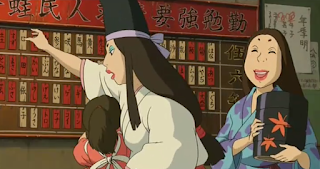
In this shot, Chihiro has been thrown upside down, this represents how Chihiro's life has been turned upside down. As well as this, in the shot, Chihiro is the only person in the shot, this shows the audience that she is all alone and doesn't have anyone to help her.
For this film, I would suggest that the target audience is children and their older siblings or parents. I would say that this is the target audience because of the age rating being Universal and suitable for all viewers. Also, the whimsical nature of this film being about children’s toys who come to life is the perfect narrative for children as it would be almost a dream-come-true. It plays with the ideas of what the children imagine when they are playing with their own toys and therefore, it becomes easy for the children to relate to the film. The film is also aimed at older teenagers and adults, as older siblings or parents would take their children to watch the film. This is shown through sensitive themes like maturity and outgrowing their toys. This is a theme that adults will be able to relate to, more especially older teenagers as this is something that would have happened to them more recently. Another important factor to consider when determining the target audience for ‘Toy Story 3’ is that it is a sequel for the film ‘Toy Story that came out in 1995, fifteen years before ‘Toy Story 3’. This would mean that any children who watched the original when it came out in 1995, would be fifteen years older, and would be a similar age to the now grown up Andy.
One example of how 'Toy Story 3' meets it's target audience in the scene where Ken is showing Barbie all his clothes. This scene show's the film's target audience as the film as it is funny and ridiculous to the children, as well as the amusing shots and the song Le Freak by Chic (which the children would find amusing as it is funky) the scene would be very amusing and therefore would meet the target audience of children. This scene relates to the adult section of the target audience as they would appreciate the clothes and would be familiar with the song as the adults who would have grown up in the 70s-80s would recognise these 'outdated' clothes as these were the clothes that they would probably have worn or would have seen other people wear as they were growing up.
Another example of how 'Toy Story 3' meets the target audience is in the opening scene. In this scene, we see the inside of Andy's head as he plays with his toys. This meets the target audience as it is relatable for the children as this is the sort of thing that runs through their head when they play with their toys. This scene is also relatable for their audience as through this scene they are reminded what it was like to be a child and to have the limits of reality stretch through their imagination. For the adults who are watching, this is replicated in the final scene where we see Andy and Barney playing with the toys, but not from the perspective of a child's imagination, but through the eyes of an adult.

In this eye level two shot, we can see Buzz Lightyear light in the moonlight. The use of lighting in this shot shows us that he is of importance. However Jessie, who is in the background, is in shadows which tells the audience that she is no longer though of as important and is to be treated without dignity. This is solidified by the bars separating her from the person she used to trust. As well as this, the bars solidify her lack of freedom; she has been locked away and has practically no power. This is shown through her taking up a very small amount of space within the shot, whereas Buzz is taking up most of the room in the shot which tells the audience that he is the one with all the power.
In this low angle shot of Lotso, the audience an tell that he has all of the power over the other's fate. This is shown by the low angle as the audience are physically looking up at him. As well as this, we can see he has all the power as he is standing next to the button that will free the others from a certain death, but the distance between Lotso and the button show the audience that he will not free them. Within the shot, there is a red glow (from the incinerator) which not only is a reminder of the death that awaits the others, but also makes the audience think about the bloodshed, and the love that the friends share that will die along with them as these are what is associated with the colour red.
In this high angle wide shot, we can see that the toys who are about to die, are ultimately insignificant. This is shown through making them seem small against the size of the fire. Although to us and to Andy the toys mean a lot, within their world, their absence will not make a huge difference. This makes their death even more emotional and important to the audience.
In this medium shot, the focus is on Buzz's hand which is being reached towards Woody, however the hand is reaching towards the camera and the audience behind it. This makes it as though Buzz is reaching out to comfort the audience who are also preparing themselves for the death of these characters. For audience members who have watched all of the films in the franchise since 1995, it is as if he is saying to them "we're with you to the end".
In this high angle wide shot, Woody is centred in the middle, this shows he is the main character to focus on as he was Andy's main toy. An important thing to note is that not only is he in the centre but he is also alone in the centre. In this moment, while everyone else is clinging to each other, he is without Andy and has nobody else to turn to. Also Woody is stretched out. This shows us that he was the glue that binds all the toys together. It could also show the internal conflict about loosing Andy that has been troubling him throughout the film as he is physically being pulled in to directions. This sort of scene is important in children's films as it helps prepare them for events in the future of loosing a loved one and introduces them to the idea of death.
In this low angle over the shoulder two shot, we can see Andy who is physically towering over Barney and the audience which shows us that giving up Woody is entirely his decision and he has all the power in making that decision. In this shot, we can see that Woody is completely surrounded by Andy, this also tells the audience that the decision over Woody's fate entirely rests on Andy.
In this shot, we can see the final stage of Todorov's theory of equilibrium as all is good again for the characters. In the first scene of the film, Andy is playing with his toys, and in this shot, we can see Barney playing with her new toys. In the foreground we can see the satisfied faces of the toys whist they are being played with, and in the background we can see Barney playing with her new toys. This shows that there will be a new equilibrium where the toys get played with regularly again. This is emphasised by the pathetic fallacy in the shot, the weather is a beautiful sunny day which shows us that all is great again.
This shot also shows us the final stage of Todorov's theory as it is replicates the opening shot from the original film, this tells the audience who have seen the original film that this is a new beginning for these toys and that this is not the end.
‘Spirited Away’ is a Studio Ghibli animated feature film originally released in July 2001, and then rereleased in English in 2003. ‘Spirited Away’ is a Japanese anime that has been translated into over 17 different languages. The English dub was supervised by Pixar animator John Lasseter. ‘Spirited Away’ was released to buy on DVD across the world. The international viewership meant that the film became incredibly popular with audiences around the world. In 2003, ‘Spirited Away’ became the first non-English language film to win an Academy Award. ‘Spirited Away’ is a hand drawn animation, meaning that each individual frame was drawn and painted by hand.
‘Spirited Away’, as a coming of age film is aimed at children and young teenagers, this can also br suggested through the BBFC rating being a PG. Despite the lead protagonist being female, the film is not aimed at one particular gender, but for all. The use of practical humour in events like the giant baby being turned into a mouse, or the three bouncing heads that act like jesters or fools. However, some theorists believe that though on the surface this is a film for children, there is a much deeper level of meaning that makes this a film for adults. These theorists suggest that the film is a metaphor for child prostitution. In the Japanese Edo era, bathhouses (where this film is set) were places where men would go to meet “Yuna”. This was the name for female attendants of the bath house that were also prostitutes. “Yuna” is also the name of the race of spirits who work in the bathhouse within the film. In the theory, the character ‘No-Face’ is supposed to represent a man who is constantly asking after a young underage girl, after being turned down repeatedly he tries to bribe her with tokens. Other indications of this theory include ‘Chihiro’ having to sign her name away and becoming ‘Sen’ and then forgetting her real name, this represents the idea of women signing their lives away and forgetting who they are outside of their work. This theory is something that would be completely missed by children and young teenagers watching, therefore director Hayao Miyazaki is able to create a film suitable for children, whilst addressing an important political issue to the adults watching.
‘Spirited Away’ is a feature animation with a running time of 2hours and 5minutes. This is quite long for an animation as the average length for a feature animation is 1hour 30minutes-1hour 40minutes. However, ‘Spirited Away’ is the perfect example of children not being bored by long films as it is captivating from the first frame through to the last. The story does not drag on, nor does it move on too quickly. It is the perfect ratio of plot to time.
In this high angle shot, the high angle and the irregular positioning of how the girl is sitting in the car shows the audience that something is wrong. From the dialogue talking about how the family is moving it is easy to understand why she may be upset. The high angle shows us that she is feeling down as she is beneath the audience.
In this low angle wide shot, we can see how vulnerable and innocent Chihiro is as she is tiny in comparison to the large buildings and the tall tree. Trees are very tall and important and the taller they are the older they are. This is a really tall tree which shows that it and the places that are around Chihiro are very old and important.
In this shot, Chihiro has been thrown upside down, this represents how Chihiro's life has been turned upside down. As well as this, in the shot, Chihiro is the only person in the shot, this shows the audience that she is all alone and doesn't have anyone to help her.
In this shot, Chihiro is being squished by the other ladies, this shows the audience that Chihiro is finding it difficult to fit in and is being oppressed by her other workers.
This high angle shot is of all the people in the bathhouse working together to achieve the same goal, this represents how Chihiro is finally fitting in at the bathhouse.
In this wide shot we can see Chihiro as small and alone, this shows the audience that Chihiro doesn't have anyone to help her. It can also be seen that Chihiro is climbing a ladder. Climbing ladders is often used as a way showing that a characters are having their status raised or are becoming stronger. This shows us that Chihiro has perseverance. Perseverance is an important lesson to teach children and young teenagers, as this is the target audience for the film, this is a great shot type to be in the film.
Tuesday, March 12, 2019
P2: Describe the uses for digitised animation in the media RESUBMISSION.
Animated films:
Claymation is a form of stop-motion animation where all the sets and figures were made out of clay. Although the term 'Claymation' wasn't trademarked until 1978 by Will Vinton, clay has been used in stop motion animation since the early 1900s. The first example of a claymation film was 'The Sculptor's Welsh Rarebit Dream', made in 1908 and was a combination of live action and claymation. Some of the first popular claymation films were the Wallace and Gromit shorts. The target audience for these shorts are children because of the humour and the themes of going against authority. However, Dr. Brian Clifford (professor of phycology) said that "Animation is more than a form of escapism. It reflects everyone's desire to be bold enough to turn against authority at some level... The idea that the films are for children is a myth - adults find a release in them.". Overall the comedic aspect of the animated films creates an escapism for all ages. The genre of Wallace and Gromit is comedy as the bright colours of the clay and the whimsical stories, makes making this products with the genre being comedy very easy. As well as this, as Wallace and Gromit is aimed at children, it wouldn't be appropriate if the genre was scary or dark, comedy is the perfect genre to keep the target audience (children) amused.
https://www.independent.co.uk/arts-entertainment/films/features/how-wallace-and-gromit-conquered-the-world-316354.html
https://www.brighthub.com/multimedia/video/articles/59445.aspx
Children's television:
2D cartoons as a form of children's television is highly affective as the use of bright colours and slapstick humour is amusing to kids. 2D children's cartoons have been around from the beginning of animation. A great example of this is the Looney Toons, produced by Warner Brothers. Looney Toons, featuring characters including but not limited to: Bugs Bunny, Daffy Duck, Porky Pig, Elmer Fudd, Tweety, Sylvester, Granny, Yosemeite Sam, Foghorn Leghorn, Marvin the Martian, Pepé Le Pew, Speedy Gonzales, Tasmanian Devil, Road Runner, and Wile E. Coyote. The first Bugs Bunny cartoon was aired July 27 1940. The genre of Looney Tunes is comedy, this is shown through the slapstick and unrealistically violent humour, as it is the perfect comedy to amuse children who won't understand clever humour, as well as this the short length of the cartoons is the perfect length for children who have short attention spans. As the target audience of these animations are children, it would be inappropriate for the genre to be horror, or scary. Therefore the genre is usually comedy as that is what would interest the target audience the most. Features of the comedy genre is that they are funny, contain bright colours and non-graphic violence. This makes comedy a perfect genre to use for children's television.
Video Games:
3D animation in video games first started in the 1970s. One of the earliest 3D animated video games, is Battlezone. Battlezone was a first person shooter released in 1980, for the Nintendo 64. The 3D animation of Battlezone's technology was used by the U.S. army to train tank gunners. The realistic nature of the animation made it more interesting and exciting for the gamers. The genre for this type of game is a warfare and battle. One feature of a warfare and battle game is that it contains weapons and takes place on different battlegrounds, this is shown in the game through the use of weapons and it taking place on battlegrounds. Another way that the genre of warfare and battle is shown though the animation of Battlezone is though the use of colour. The colours in the animation are black and other dark colours which portray the negative aspect of the game; as well as this, the colour green shows the genre of the show through its relation to armies through the uniforms and camouflage that the soldiers wear.
Claymation is a form of stop-motion animation where all the sets and figures were made out of clay. Although the term 'Claymation' wasn't trademarked until 1978 by Will Vinton, clay has been used in stop motion animation since the early 1900s. The first example of a claymation film was 'The Sculptor's Welsh Rarebit Dream', made in 1908 and was a combination of live action and claymation. Some of the first popular claymation films were the Wallace and Gromit shorts. The target audience for these shorts are children because of the humour and the themes of going against authority. However, Dr. Brian Clifford (professor of phycology) said that "Animation is more than a form of escapism. It reflects everyone's desire to be bold enough to turn against authority at some level... The idea that the films are for children is a myth - adults find a release in them.". Overall the comedic aspect of the animated films creates an escapism for all ages. The genre of Wallace and Gromit is comedy as the bright colours of the clay and the whimsical stories, makes making this products with the genre being comedy very easy. As well as this, as Wallace and Gromit is aimed at children, it wouldn't be appropriate if the genre was scary or dark, comedy is the perfect genre to keep the target audience (children) amused.
https://www.independent.co.uk/arts-entertainment/films/features/how-wallace-and-gromit-conquered-the-world-316354.html
https://www.brighthub.com/multimedia/video/articles/59445.aspx
Children's television:
2D cartoons as a form of children's television is highly affective as the use of bright colours and slapstick humour is amusing to kids. 2D children's cartoons have been around from the beginning of animation. A great example of this is the Looney Toons, produced by Warner Brothers. Looney Toons, featuring characters including but not limited to: Bugs Bunny, Daffy Duck, Porky Pig, Elmer Fudd, Tweety, Sylvester, Granny, Yosemeite Sam, Foghorn Leghorn, Marvin the Martian, Pepé Le Pew, Speedy Gonzales, Tasmanian Devil, Road Runner, and Wile E. Coyote. The first Bugs Bunny cartoon was aired July 27 1940. The genre of Looney Tunes is comedy, this is shown through the slapstick and unrealistically violent humour, as it is the perfect comedy to amuse children who won't understand clever humour, as well as this the short length of the cartoons is the perfect length for children who have short attention spans. As the target audience of these animations are children, it would be inappropriate for the genre to be horror, or scary. Therefore the genre is usually comedy as that is what would interest the target audience the most. Features of the comedy genre is that they are funny, contain bright colours and non-graphic violence. This makes comedy a perfect genre to use for children's television.
Video Games:
3D animation in video games first started in the 1970s. One of the earliest 3D animated video games, is Battlezone. Battlezone was a first person shooter released in 1980, for the Nintendo 64. The 3D animation of Battlezone's technology was used by the U.S. army to train tank gunners. The realistic nature of the animation made it more interesting and exciting for the gamers. The genre for this type of game is a warfare and battle. One feature of a warfare and battle game is that it contains weapons and takes place on different battlegrounds, this is shown in the game through the use of weapons and it taking place on battlegrounds. Another way that the genre of warfare and battle is shown though the animation of Battlezone is though the use of colour. The colours in the animation are black and other dark colours which portray the negative aspect of the game; as well as this, the colour green shows the genre of the show through its relation to armies through the uniforms and camouflage that the soldiers wear.
https://www.techradar.com/uk/news/gaming/the-evolution-of-3d-games-700995
P1: Explain the different techniques for animation RESUBMISSION.
Animation is a way of creating the illusion that inanimate objects are moving through playing pictures in succession; however there is more than one way to animate. One type of animation is cel animation. Cel animation was first used in 1914 and is created by each individual part of the frame being drawn on separate pieces of transparent paper and then aligned at the end of the process. The frames are then played in succession to give the illusion of movement. An example of this is Disney's comedic short; Steamboat Willie (1928). The genre of this animation is a comedy as the goal of it is to make people laugh.
https://www.imdb.com/title/tt0019422/mediaviewer/rm1339690752
Another type of animation is stop motion animation. Stop motion animation is when photos are taken of dolls or puppets and small movements are made between each photo. The photos are then played in quick succession to show the movement. An example of stop motion animation is the film ParaNorman. ParaNorman is a comedic horror film aimed at children. The genre of ParaNorman is a family horror film as it is is about a boy who can see ghosts who gets attacked by zombies, but is also aimed for children and families. In the film ParaNorman, all the sets and people are created. There are different faces with different facial expressions for each character. These are interchangeable for what emotion the animator is wanting to convey.
https://www.wired.com/2013/02/paranorman-oscar-art/
http://collect3d.com/features/faces-paranorman/
Another type of animation is motion capture. Motion capture is a form of animation that transfers actor's movements into three-dimensional graphics by tracking position markers on the actors body. It is used in the military, medical facilities, sports and entertainment. An example of this is the film The Adventures of Tintin: The Secrets of the Unicorn. The genre of this is a children's adventure comedy film. This is a fully animated film, filmed in motion capture. The director, Steven Spielberg, said in an interview " We felt it was necessary to make this picture using motion-capture technology because we wanted to honour Hergé" (Hergé being the original creator of Tintin).
https://news.avclub.com/for-only-700-you-too-can-own-look-silly-in-a-motion-c-1798285529
Another type of animation is live action animation, this is the combination of live action and traditional animation. This can be seen in films like Who Framed Roger Rabbit and Space Jam and the genre of both of these is comedy. These films were created by having the live action actors shoot all their scenes first, then each frame was turned into a photo that was drawn over by the animators. The animators drew and painted each cel of animation by hand over the picture.
https://www.spotern.com/fr/spot/movie/qui-veut-la-peau-de-roger-rabbit/77954/la-cravate-de-eddie-valiant-bob-hoskins-dans-qui-veut-la-peau-de-roger-rabbit
https://uproxx.com/movies/space-jam-michael-jordan-behind-the-scenes/
A different type of live action animation is rotoscoping. Rotoscoping is a form of animation where animators draw over motion picture footage frame by frame to give more realistic movement. This technique was used in Disney's Alice in Wonderland (1951). The genre of this film is family adventure fantasy.
https://www.tumblr.com/tagged/Bodysuits-white
https://www.imdb.com/title/tt0019422/mediaviewer/rm1339690752
Another type of animation is stop motion animation. Stop motion animation is when photos are taken of dolls or puppets and small movements are made between each photo. The photos are then played in quick succession to show the movement. An example of stop motion animation is the film ParaNorman. ParaNorman is a comedic horror film aimed at children. The genre of ParaNorman is a family horror film as it is is about a boy who can see ghosts who gets attacked by zombies, but is also aimed for children and families. In the film ParaNorman, all the sets and people are created. There are different faces with different facial expressions for each character. These are interchangeable for what emotion the animator is wanting to convey.
https://www.wired.com/2013/02/paranorman-oscar-art/
http://collect3d.com/features/faces-paranorman/
Another type of animation is motion capture. Motion capture is a form of animation that transfers actor's movements into three-dimensional graphics by tracking position markers on the actors body. It is used in the military, medical facilities, sports and entertainment. An example of this is the film The Adventures of Tintin: The Secrets of the Unicorn. The genre of this is a children's adventure comedy film. This is a fully animated film, filmed in motion capture. The director, Steven Spielberg, said in an interview " We felt it was necessary to make this picture using motion-capture technology because we wanted to honour Hergé" (Hergé being the original creator of Tintin).
https://news.avclub.com/for-only-700-you-too-can-own-look-silly-in-a-motion-c-1798285529
Another type of animation is live action animation, this is the combination of live action and traditional animation. This can be seen in films like Who Framed Roger Rabbit and Space Jam and the genre of both of these is comedy. These films were created by having the live action actors shoot all their scenes first, then each frame was turned into a photo that was drawn over by the animators. The animators drew and painted each cel of animation by hand over the picture.
https://www.spotern.com/fr/spot/movie/qui-veut-la-peau-de-roger-rabbit/77954/la-cravate-de-eddie-valiant-bob-hoskins-dans-qui-veut-la-peau-de-roger-rabbit
https://uproxx.com/movies/space-jam-michael-jordan-behind-the-scenes/
A different type of live action animation is rotoscoping. Rotoscoping is a form of animation where animators draw over motion picture footage frame by frame to give more realistic movement. This technique was used in Disney's Alice in Wonderland (1951). The genre of this film is family adventure fantasy.
https://www.tumblr.com/tagged/Bodysuits-white
Monday, February 18, 2019
D2- Justify the choice of animation technique for the frame rate and duration.
Justify the choice of technique for the frame rate and duration.
I decided that the frame rate for my animation should be 12 frames per second as I have been creating a very basic animation that does not need very fluent motion for it to be affective. If I had decided to animate at 24 frames per second, I would have needed to animate on 2s, therefore it was easier to create the animation at 12 frames per second.
The animation is also only 32 seconds long. I decided to make my animation this length as it is specified in the brief that the animation needs to be between 30-90 seconds. The brief also specifies that the animation will be used as a loading screen on the app and on the website, usually, when apps and website pages load, it does not take much longer than 30 seconds. Therefore, I made the animation this length so that it would fit the brief, but also be the best length so not to bore the audience while their app/web page is loading.
I decided that the frame rate for my animation should be 12 frames per second as I have been creating a very basic animation that does not need very fluent motion for it to be affective. If I had decided to animate at 24 frames per second, I would have needed to animate on 2s, therefore it was easier to create the animation at 12 frames per second.
The animation is also only 32 seconds long. I decided to make my animation this length as it is specified in the brief that the animation needs to be between 30-90 seconds. The brief also specifies that the animation will be used as a loading screen on the app and on the website, usually, when apps and website pages load, it does not take much longer than 30 seconds. Therefore, I made the animation this length so that it would fit the brief, but also be the best length so not to bore the audience while their app/web page is loading.
Subscribe to:
Posts (Atom)
D2: Justify the choices of animation technique for the frame rate and duration RESUBMISSION.
Justify the choice of technique for the frame rate and duration. I decided that the frame rate for my animation should be 12 frames per se...
-
Optimise the content for use in the final animation. After showing the animation to some peers, I was shown some ways in which I could imp...
-
Create the content for the animation. I have created the animation and exported it in two different file sizes, one for a mobile device...
-
Animated films: Claymation is a form of stop-motion animation where all the sets and figures were made out of clay. Although the term ...