Compare digital animations from two different countries around the world. You should reference animation styles, characters, themes and narratives.
'Monsters, Inc' is an animated feature length film made by Pixar in 2001. It was produced in the United states by John Lasseter and was directed by Pete Docter. The film is about two monsters, 'Sully' played by John Goodman and 'Mike' played by Billy Crystal, who find a human child called 'Boo' and their adventures in trying to get 'Boo' home. 'Howl's Moving Castle' is a Japanese animated feature length film made in 2004. It was made by the animation company Studio Ghibli, and was directed by Hayao Miyazaki. The film is about a young women called 'Sofie' who is cursed to look like an old lady by an evil witch, and her adventures with a young wizard called 'Howl'.
'Monsters, Inc' is an a 3D computer generated animation film, it was important that the animation was 3-dimensional as it allows for more detailed set locations and to give a better indication of texture. The more detailed texture allowed the animators to make the characters look as impressive as they could. Fur on characters such as 'Sully' were rendered in more detail and allowed for more lifelike looking humans like 'Boo'.
Western audiences often prefer computer generated animation as it is more fashionable and often prefer more detailed animation. Eastern audiences generally prefer traditional 2-dimensional animation as it is what they are used to. 'Howl's Moving Castle' is 2D hand drawn animation. The backgrounds are drawn it lots of detail but the characters and objects in the foreground are in less detail. It is obvious that the characters are human but they are not as lifelike as some 3D animation. The characters and objects that the characters interact with are drawn using basic shapes and lines and the colours and shading is not blended but distinctly separate, whereas the backgrounds look like paintings and are in great details.
In 'Monsters, Inc', the main characters are 'Sully' a large blue and purple monsters who has the physique similar to a bear. He works for the company 'Monsters Incorporated' as a 'Scarer', meaning his job is to collect 'scream energy' to power his city by scaring human children. At the beginning of the film, we see him as a tough character, however, the audience later learns that he is not as tough as he seams as not only do we see him scared and panicked, but we also see him compassionate and loving. Another important character in 'Monsters, Inc' is 'Mike Wazowski', he is a green one-eyed monster who has the approximate physique of an egg. At the beginning of the film we see him untrusting and unreliable, however, as the film develops er see him become more reliable and caring of 'Boo'. The protagonist in 'Howl's Moving Castle' is a young girl called 'Sofie' who is really insecure about the way she looks and who she is. As the film develops, 'Sofie' is magically transformed into and old lady and begins to lose her insecurities. With the help from 'Howl', as her spell is broken and her youth is returned, he insecurities disappear completely. The other main protagonist in 'Howl's Moving Castle' is the character 'Howl', a young wizard. He appears to be confident and unafraid, but we learn that he is actually terrified of people controlling him and that his fear comes from still having the heart of a child. The characters in western films are all driven by the plot and have a character arc, but the arc is a result of the story rather than what leads it. However, it is clear that in eastern animated films, the character arc is what drives the story through to its conclusion.
In 'Monsters, Inc' the narrative is character driven. All of the events occur because of decisions or actions that the characters decide to make. For example; 'Boo' gets stuck in the monster world because 'Randall' (the antagonist) decides to kidnap her and experiment his new machine on her. Whereas, the narrative of 'Howl's Moving Castle' is event driven. For example, 'Sofie' wandered into 'Howl's castle because she was cursed to be old and had to leave her home. 'Howl's Moving Castle' is very fast paced and doesn't fit easily into the three act structure, whereas 'Monsters, Inc' fits really easily into the three act structure.
Both films have themes about friendship, familial love, and not all monsters are horrible. Overall, the themes in 'Monsters, Inc' are simpler than the themes in 'Howl's Moving Castle' as it they are easy to spot and are simpler to explain to children and are good morals for children, whereas the themes in 'Howl's Moving Castle' are complex, but all based around love and how to love a monster. 'Monsters, Inc' impacts the audience through teaching the audience a lesson whereas 'Howl's Moving Castle' impacts the audience though asking them questions of love, and how to love.
Monday, November 5, 2018
Tuesday, October 16, 2018
M1- Assess the suitability of animations for the target audience.
‘Toy Story 3’ is a Pixar animated film released in 2010. ‘Toy Story 3’ is the third instalment in Pixar’s debut film series ‘Toy Story’. It is a 3D computer animated film starring Tim Alan as ‘Buzz Lightyear’ and Tom Hanks as ‘Woody’. ‘Toy Story 3’ was originally released in cinemas June 18th 2010 and then released to buy on DVD/Blu-ray later in the year. Since then it has been available on streaming site such as Netflix. The film has previously been on streaming site, this makes it easier for 21st century children to be able to watch it as using smart tablets and apps as children seem to be naturally fluent in using this sort of tech, much more then learning how to use a DVD player.
For this film, I would suggest that the target audience is children and their older siblings or parents. I would say that this is the target audience because of the age rating being Universal and suitable for all viewers. Also, the whimsical nature of this film being about children’s toys who come to life is the perfect narrative for children as it would be almost a dream-come-true. It plays with the ideas of what the children imagine when they are playing with their own toys and therefore, it becomes easy for the children to relate to the film. The film is also aimed at older teenagers and adults, as older siblings or parents would take their children to watch the film. This is shown through sensitive themes like maturity and outgrowing their toys. This is a theme that adults will be able to relate to, more especially older teenagers as this is something that would have happened to them more recently. Another important factor to consider when determining the target audience for ‘Toy Story 3’ is that it is a sequel for the film ‘Toy Story that came out in 1995, fifteen years before ‘Toy Story 3’. This would mean that any children who watched the original when it came out in 1995, would be fifteen years older, and would be a similar age to the now grown up Andy.
In this eye level two shot, we can see Buzz Lightyear light in the moonlight. The use of lighting in this shot shows us that he is of importance. However Jessie, who is in the background, is in shadows which tells the audience that she is no longer though of as important and is to be treated without dignity. This is solidified by the bars separating her from the person she used to trust. As well as this, the bars solidify her lack of freedom; she has been locked away and has practically no power. This is shown through her taking up a very small amount of space within the shot, whereas Buzz is taking up most of the room in the shot which tells the audience that he is the one with all the power.
In this low angle shot of Lotso, the audience an tell that he has all of the power over the other's fate. This is shown by the low angle as the audience are physically looking up at him. As well as this, we can see he has all the power as he is standing next to the button that will free the others from a certain death, but the distance between Lotso and the button show the audience that he will not free them. Within the shot, there is a red glow (from the incinerator) which not only is a reminder of the death that awaits the others, but also makes the audience think about the bloodshed, and the love that the friends share that will die along with them as these are what is associated with the colour red.
In this high angle wide shot, we can see that the toys who are about to die, are ultimately insignificant. This is shown through making them seem small against the size of the fire. Although to us and to Andy the toys mean a lot, within their world, their absence will not make a huge difference. This makes their death even more emotional and important to the audience.
In this medium shot, the focus is on Buzz's hand which is being reached towards Woody, however the hand is reaching towards the camera and the audience behind it. This makes it as though Buzz is reaching out to comfort the audience who are also preparing themselves for the death of these characters. For audience members who have watched all of the films in the franchise since 1995, it is as if he is saying to them "we're with you to the end".
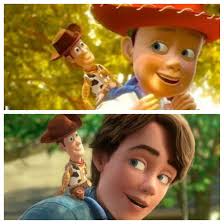
In this high angle wide shot, Woody is centred in the middle, this shows he is the main character to focus on as he was Andy's main toy. An important thing to note is that not only is he in the centre but he is also alone in the centre. In this moment, while everyone else is clinging to each other, he is without Andy and has nobody else to turn to. Also Woody is stretched out. This shows us that he was the glue that binds all the toys together. It could also show the internal conflict about loosing Andy that has been troubling him throughout the film as he is physically being pulled in to directions. This sort of scene is important in children's films as it helps prepare them for events in the future of loosing a loved one and introduces them to the idea of death.
In this low angle over the shoulder two shot, we can see Andy who is physically towering over Barney and the audience which shows us that giving up Woody is entirely his decision and he has all the power in making that decision. In this shot, we can see that Woody is completely surrounded by Andy, this also tells the audience that the decision over Woody's fate entirely rests on Andy.
In this shot, we can see the final stage of Todorov's theory of equilibrium as all is good again for the characters. In the first scene of the film, Andy is playing with his toys, and in this shot, we can see Barney playing with her new toys. In the foreground we can see the satisfied faces of the toys whist they are being played with, and in the background we can see Barney playing with her new toys. This shows that there will be a new equilibrium where the toys get played with regularly again. This is emphasised by the pathetic fallacy in the shot, the weather is a beautiful sunny day which shows us that all is great again.
This shot also shows us the final stage of Todorov's theory as it is replicates the opening shot from the original film, this tells the audience who have seen the original film that this is a new beginning for these toys and that this is not the end.
‘Spirited Away’ is a Studio Ghibli animated feature film originally released in July 2001, and then rereleased in English in 2003. ‘Spirited Away’ is a Japanese anime that has been translated into over 17 different languages. The English dub was supervised by Pixar animator John Lasseter. ‘Spirited Away’ was released to buy on DVD across the world. The international viewership meant that the film became incredibly popular with audiences around the world. In 2003, ‘Spirited Away’ became the first non-English language film to win an Academy Award. ‘Spirited Away’ is a hand drawn animation, meaning that each individual frame was drawn and painted by hand.
‘Spirited Away’, as a coming of age film is aimed at children and young teenagers. Despite the lead protagonist being female, the film is not aimed at one particular gender, but for all. The use of practical humour in events like the giant baby being turned into a mouse, or the three bouncing heads that act like jesters or fools. However, some theorists believe that though on the surface this is a film for children, there is a much deeper level of meaning that makes this a film for adults. These theorists suggest that the film is a metaphor for child prostitution. In the Japanese Edo era, bathhouses (where this film is set) were places where men would go to meet “Yuna”. This was the name for female attendants of the bath house that were also prostitutes. “Yuna” is also the name of the race of spirits who work in the bathhouse within the film”. In the theory, the character ‘No-Face’ is supposed to represent a man who is constantly asking after a young underage girl, after being turned down repeatedly he tries to bribe her with tokens. Other indications of this theory include ‘Chihiro’ having to sign her name away and becoming ‘Sen’ and then forgetting her real name, this represents the idea of women signing their lives away and forgetting who they are outside of their work. This theory is something that would be completely missed by children and young teenagers watching, therefore director Hayao Miyazaki is able to create a film suitable for children, whilst addressing an important political issue to the adults watching.
‘Spirited Away’ is a feature animation with a running time of 2hours and 5minutes. This is quite long for an animation as the average length for a feature animation is 1hour 30minutes-1hour 40minutes. However, ‘Spirited Away’ is the perfect example of children not being bored by long films as it is captivating from the first frame through to the last. The story does not drag on, nor does it move on too quickly. It is the perfect ratio of plot to time.
In this high angle shot, the high angle and the irregular positioning of how the girl is sitting in the car shows the audience that something is wrong. From the dialogue talking about how the family is moving it is easy to understand why she may be upset. The high angle shows us that she is feeling down as she is beneath the audience.
In this low angle wide shot, we can see how vulnerable and innocent Chihiro is as she is tiny in comparison to the large buildings and the tall tree. Trees are very tall and important and the taller they are the older they are. This is a really tall tree which shows that it and the places that are around Chihiro are very old and important.
In this shot, Chihiro has been thrown upside down, this represents how Chihiro's life has been turned upside down. As well as this, in the shot, Chihiro is the only person in the shot, this shows the audience that she is all alone and doesn't have anyone to help her.
In this shot, Yubaba is shown to have all the power as she is taking up the most space in the shot, Chihiro is tiny in the shot and therefore she has less power. 
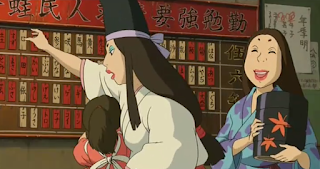
In this shot, Chihiro is being squished by the other ladies, this shows the audience that Chihiro is finding it difficult to fit in and is being oppressed by her other workers.
This high angle shot is of all the people in the bathhouse working together to achieve the same goal, this represents how Chihiro is finally fitting in at the bathhouse.
In this wide shot we can see Chihiro as small and alone, this shows the audience that Chihiro doesn't have anyone to help her. It can also be seen that Chihiro is climbing a ladder. Climbing ladders is often used as a way showing that a characters are having their status raised or are becoming stronger. This shows us that Chihiro has perseverance. Perseverance is an important lesson to teach children and young teenagers, as this is the target audience for the film, this is a great shot type to be in the film.
Wednesday, September 26, 2018
P2- Describe the uses for digitalised animation in the media.
Animated films:
Claymation is a form of stop-motion animation where all the sets and figures were made out of clay. Although the term 'Claymation' wasn't trademarked until 1978 by Will Vinton, clay has been used in stop motion animation since the early 1900s. The first example of a claymation film was 'The Sculptor's Welsh Rarebit Dream', made in 1908 and was a combination of live action and claymation. Some of the first popular claymation films were the Wallace and Gromit shorts. The target audience for these shorts are children because of the humour and the themes of going against authority. However, Dr. Brian Clifford (professor of phycology) said that "Animation is more than a form of escapism. It reflects everyone's desire to be bold enough to turn against authority at some level... The idea that the films are for children is a myth - adults find a release in them.". Overall the comedic aspect of the animated films creates an escapism for all ages.
https://www.independent.co.uk/arts-entertainment/films/features/how-wallace-and-gromit-conquered-the-world-316354.html
https://www.brighthub.com/multimedia/video/articles/59445.aspx
Children's television:
2D cartoons as a form of children's television is highly affective as the use of bright colours and slapstick humour is amusing to kids. 2D children's cartoons have been around from the beginning of animation. A great example of this is the Looney Toons, produced by Warner Brothers. Looney Toons, featuring characters including but not limited to: Bugs Bunny, Daffy Duck, Porky Pig, Elmer Fudd, Tweety, Sylvester, Granny, Yosemeite Sam, Foghorn Leghorn, Marvin the Martian, Pepé Le Pew, Speedy Gonzales, Tasmanian Devil, Road Runner, and Wile E. Coyote. The first Bugs Bunny cartoon was aired July 27 1940. The slapstick and unrealistically violent humour is the perfect comedy to amuse children who won't understand clever humour, as well as this the short length of the cartoons is the perfect length for children who have short attention spans.
Video Games:
3D animation in video games first started in the 1970s. One of the earliest 3D animated video games, is Battlezone. Battlezone was a first person shooter released in 1980, for the Nintendo 64. The 3D animation of Battlezone, the US army used it's technology to train tank gunners. The realistic nature of the animation made it more interesting and exciting for the gamers.
Claymation is a form of stop-motion animation where all the sets and figures were made out of clay. Although the term 'Claymation' wasn't trademarked until 1978 by Will Vinton, clay has been used in stop motion animation since the early 1900s. The first example of a claymation film was 'The Sculptor's Welsh Rarebit Dream', made in 1908 and was a combination of live action and claymation. Some of the first popular claymation films were the Wallace and Gromit shorts. The target audience for these shorts are children because of the humour and the themes of going against authority. However, Dr. Brian Clifford (professor of phycology) said that "Animation is more than a form of escapism. It reflects everyone's desire to be bold enough to turn against authority at some level... The idea that the films are for children is a myth - adults find a release in them.". Overall the comedic aspect of the animated films creates an escapism for all ages.
https://www.independent.co.uk/arts-entertainment/films/features/how-wallace-and-gromit-conquered-the-world-316354.html
https://www.brighthub.com/multimedia/video/articles/59445.aspx
Children's television:
2D cartoons as a form of children's television is highly affective as the use of bright colours and slapstick humour is amusing to kids. 2D children's cartoons have been around from the beginning of animation. A great example of this is the Looney Toons, produced by Warner Brothers. Looney Toons, featuring characters including but not limited to: Bugs Bunny, Daffy Duck, Porky Pig, Elmer Fudd, Tweety, Sylvester, Granny, Yosemeite Sam, Foghorn Leghorn, Marvin the Martian, Pepé Le Pew, Speedy Gonzales, Tasmanian Devil, Road Runner, and Wile E. Coyote. The first Bugs Bunny cartoon was aired July 27 1940. The slapstick and unrealistically violent humour is the perfect comedy to amuse children who won't understand clever humour, as well as this the short length of the cartoons is the perfect length for children who have short attention spans.
Video Games:
3D animation in video games first started in the 1970s. One of the earliest 3D animated video games, is Battlezone. Battlezone was a first person shooter released in 1980, for the Nintendo 64. The 3D animation of Battlezone, the US army used it's technology to train tank gunners. The realistic nature of the animation made it more interesting and exciting for the gamers.
https://www.techradar.com/uk/news/gaming/the-evolution-of-3d-games-700995
Tuesday, September 18, 2018
P1- Explain the different techniques for animation.
Animation is a way of creating the illusion that inanimate objects are moving through playing pictures in succession; however there is more than one way to animate. One type of animation is cel animation. Cel animation was first used in 1914 and is created by each individual part of the frame being drawn on separate pieces of transparent paper and then aligned at the end of the process. The frames are then played in succession to give the illusion of movement. An example of this is Disney's Steamboat Willie (1928)
https://www.imdb.com/title/tt0019422/mediaviewer/rm1339690752
Another type of animation is stop motion animation. Stop motion animation is when photos are taken of dolls or puppets and small movements are made between each photo. The photos are then played in quick succession to show the movement. An example of stop motion animation is the film ParaNorman. In the film ParaNorman, all the sets and people are created. There are different faces with different facial expressions for each character. These are interchangeable for what emotion the animator is wanting to convey.
https://www.wired.com/2013/02/paranorman-oscar-art/
http://collect3d.com/features/faces-paranorman/
Another type of animation is motion capture. Motion capture is a form of animation that transfers actor's movements into three-dimensional graphics by tracking position markers on the actors body. It is used in the military, medical facilities, sports and entertainment. An example of this is the film The Adventures of Tintin: The Secrets of the Unicorn. This is a fully animated film, filmed in motion capture. The director, Steven Spielberg, said in an interview " We felt it was necessary to make this picture using motion-capture technology because we wanted to honour Hergé" (Hergé being the original creator of Tintin).
https://news.avclub.com/for-only-700-you-too-can-own-look-silly-in-a-motion-c-1798285529
Another type of animation is live action animation, this is the combination of live action and traditional animation. This can be seen in films like Who Framed Roger Rabbit and Space Jam. These films were created by having the live action actors shoot all their scenes first, then each frame was turned into a photo that was drawn over by the animators. The animators drew and painted each cel of animation by hand over the picture.
https://www.spotern.com/fr/spot/movie/qui-veut-la-peau-de-roger-rabbit/77954/la-cravate-de-eddie-valiant-bob-hoskins-dans-qui-veut-la-peau-de-roger-rabbit
https://uproxx.com/movies/space-jam-michael-jordan-behind-the-scenes/
A different type of live action animation is rotoscoping. Rotoscoping is a form of animation where animators draw over motion picture footage frame by frame to give more realistic movement. This technique was used in Disney's Alice in Wonderland (1951) used this technique.
https://www.tumblr.com/tagged/Bodysuits-white
https://www.imdb.com/title/tt0019422/mediaviewer/rm1339690752
Another type of animation is stop motion animation. Stop motion animation is when photos are taken of dolls or puppets and small movements are made between each photo. The photos are then played in quick succession to show the movement. An example of stop motion animation is the film ParaNorman. In the film ParaNorman, all the sets and people are created. There are different faces with different facial expressions for each character. These are interchangeable for what emotion the animator is wanting to convey.
https://www.wired.com/2013/02/paranorman-oscar-art/
http://collect3d.com/features/faces-paranorman/
Another type of animation is motion capture. Motion capture is a form of animation that transfers actor's movements into three-dimensional graphics by tracking position markers on the actors body. It is used in the military, medical facilities, sports and entertainment. An example of this is the film The Adventures of Tintin: The Secrets of the Unicorn. This is a fully animated film, filmed in motion capture. The director, Steven Spielberg, said in an interview " We felt it was necessary to make this picture using motion-capture technology because we wanted to honour Hergé" (Hergé being the original creator of Tintin).
https://news.avclub.com/for-only-700-you-too-can-own-look-silly-in-a-motion-c-1798285529
Another type of animation is live action animation, this is the combination of live action and traditional animation. This can be seen in films like Who Framed Roger Rabbit and Space Jam. These films were created by having the live action actors shoot all their scenes first, then each frame was turned into a photo that was drawn over by the animators. The animators drew and painted each cel of animation by hand over the picture.
https://www.spotern.com/fr/spot/movie/qui-veut-la-peau-de-roger-rabbit/77954/la-cravate-de-eddie-valiant-bob-hoskins-dans-qui-veut-la-peau-de-roger-rabbit
https://uproxx.com/movies/space-jam-michael-jordan-behind-the-scenes/
A different type of live action animation is rotoscoping. Rotoscoping is a form of animation where animators draw over motion picture footage frame by frame to give more realistic movement. This technique was used in Disney's Alice in Wonderland (1951) used this technique.
https://www.tumblr.com/tagged/Bodysuits-white
Subscribe to:
Posts (Atom)
D2: Justify the choices of animation technique for the frame rate and duration RESUBMISSION.
Justify the choice of technique for the frame rate and duration. I decided that the frame rate for my animation should be 12 frames per se...
-
Animated films: Claymation is a form of stop-motion animation where all the sets and figures were made out of clay. Although the term ...
-
Optimise the content for use in the final animation. After showing the animation to some peers, I was shown some ways in which I could imp...
-
Create the content for the animation. I have created the animation and exported it in two different file sizes, one for a mobile device...


